Babies are tiny humans who we handle with pure love and delicacy so that they do not feel any discomfort.
We always ensure that they feel happy and relaxed with our presence.
As they are new to this earthly environment, they have sensitive bodies. Being a parent, we always look into the small things, what they wear, what they touch, what products they use and what food they eat.
Food choices are an essential part of a baby’s growth so that they can enjoy their future with pure joy and good health.
Do you remember mommies? Your grandmothers and mothers were always ready to feed you something authentic and healthy.
As a new mom, it’s only natural to want the best guidance for your baby’s meals and nutrition.
Here, at mommies.in, we ensure all the mommies and babies receive all the guidance for their good health and lifestyle.
And this blog is for all new mommies/parents or anyone who likes taking care of these cute babies.
Let’s take a closer look at the foods that help your baby grow healthy and strong. Superfoods for Babies that every Parent Should Know.
What do superfoods for babies actually mean?
Babies eat less because of their tiny tummies; therefore, it is important to feed them the little food that contains maximum nutrients.
And these high-nutrient foods are called superfoods.
We, adults, eat many things to stay healthy, but babies can’t eat as many as we do, so they eat specific high-nutrient food, the Superfoods.
Just like a few spoonfuls of mashed banana or moong dal can nourish a baby better than a full plate of low-nutrient food.
Superfoods pack maximum nutrition into tiny portions.
Essential Superfoods for Your Little One
When it comes to feeding babies, Indian households have always trusted simple, natural, and time-tested foods.
Long before packaged baby foods existed, our grandmothers relied on wholesome ingredients like ragi, moong dal, ghee, and rice to nourish growing babies.
These traditional foods are true superfoods for babies, packed with essential nutrients that support healthy growth, digestion, and immunity.
So, trying these Indian superfoods for your baby will be a good idea.
Best Indian superfoods for babies
Indian traditional foods are considered true superfoods for babies because they are natural, easy to digest, and rich in essential nutrients.
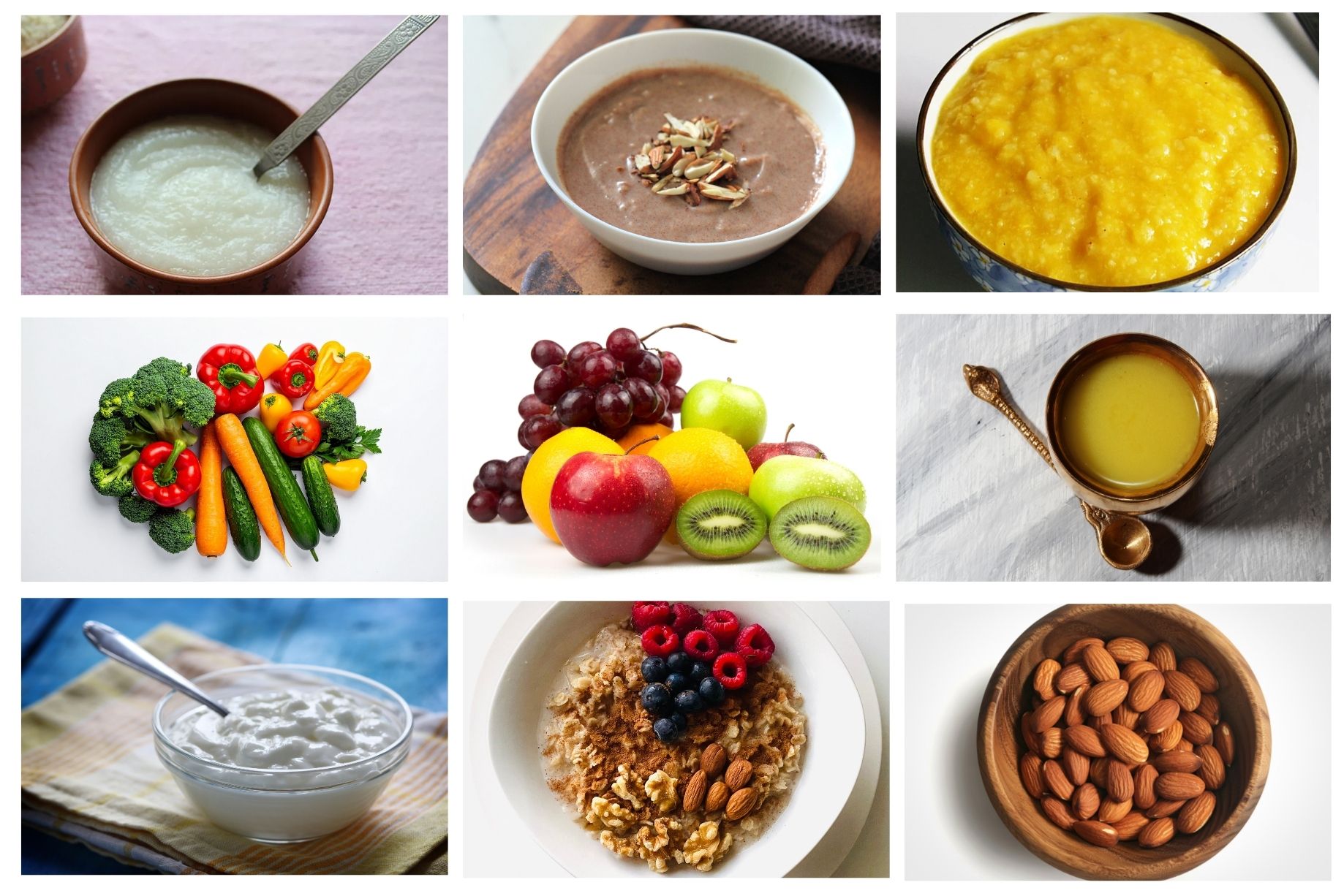
1. Rice (First Food – 6 Months+)
Rice is usually the first solid food introduced to Indian babies.
- Very easy to digest
- Low risk of allergies
- Provides instant energy
- Gentle on the stomach
Start with rice water or well-mashed soft rice. It helps babies get used to solid foods without upsetting their digestion.
2. Ragi (Finger Millet – 6 Months+)
Ragi is one of the most powerful superfoods for babies.
- Rich in calcium for strong bones and teeth.
- High in iron, it helps prevent anemia.
- High fibre content improves digestion.
- Naturally gluten-free.
Ragi porridge, aka Ragi Malt, made from soaked and sprouted ragi, supports healthy growth and weight gain.
3. Moong Dal (6–7 Months+)
Moong dal is the lightest dal and ideal for babies.
- High-quality plant protein for growth.
- Easy to digest compared to other dals.
- Supports muscle development.
- Contains iron and B vitamins.
Begin with moong dal water, then move to soft dal mash or khichdi.
4. Vegetables (6–8 Months+)
Start with mild vegetables like pumpkin, bottle gourd (lauki), carrot, and ash gourd.
- Rich in vitamins and minerals.
- Support immunity and eye health.
- Easy to digest when well-cooked.
- Introduce natural taste and texture.
Vegetables should be steamed, mashed, and introduced one at a time.
5. Fruits (6 Months+)
Fruits add natural sweetness and nutrition.
- Banana
- Apple (steamed)
- Papaya
Always mash or steam fruits before feeding.
6. Ghee (6 Months+ – Small Quantity)
Desi cow ghee is an essential part of Indian baby diets.
- Supports brain development
- Improves digestion and nutrient absorption
- Helps prevent constipation
- Boosts immunity
Start with a few drops added to rice or dal.
7. Curd (7–8 Months+)
Fresh homemade curd can be introduced gradually.
- Natural probiotic for gut health
- Improves digestion
- Rich in calcium and protein
- Strengthens immunity
Give curd during the daytime, and avoid it during a cold or cough.
8. Oats (8 Months+)
Oats are a nutritious addition to Indian baby meals.
- High fibre keeps digestion smooth.
- Good source of energy
- Keeps babies full for longer
- Easy to mix with vegetables or fruits
Cook oats until very soft and mash well.
9. Almond Powder (9–10 Months+)
Almonds should be introduced carefully.
- Supports brain development
- Rich in healthy fats and vitamin E
- Helps in healthy weight gain
Always soak, peel, dry, and powder almonds. Use only a pinch.
Note: Before introducing these superfoods, consult your pediatrician first, as every baby is unique.
Is non-veg safe as a superfood for babies?
Yes, but giving it in moderate amounts and with the baby’s comfort is most important. A little non-veg can be a great protein boost for your baby’s growth and development!
Always blend the meat to make it smooth and easy for your baby to eat. Avoid mashing it! (Blending meat makes it smooth and easy to swallow, while mashing may leave fibres that are hard to chew or cause choking.)
From 6 months onward, babies can be introduced to certain animal-based foods once solids are started.
Common Non-veg super food options in Indian diets:
Egg Yolk (Hard-Boiled) – High-quality protein and Vitamin B12 for brain development.
Chicken (Soft-Cooked) – Easy protein, iron-rich, supports growth.
Small and freshwater fishes – like Rohu, Catla (Soft-Cooked) – Rich in Omega-3 DHA, good for brain and vision improvement.
Meal times and feeding guidelines for babies
The WHO recommends introducing complementary foods at 6 months, alongside breast milk.
- 6–8 months: Feed 2–3 times a day with pureed or mashed foods.
- 9–11 months: Increase to 3–4 meals daily, gradually offering semi-solid foods.
- 12–24 months: Offer 3–4 meals plus 1–2 nutritious snacks as needed.
Tips from One-Mom-To- Other:
- As babies grow, they gradually increase food variety and texture.
- Avoid foods that may cause choking (whole grapes, raw carrots).
- Limit drinks with low nutrition (tea, coffee, sugary drinks) and juice to prevent displacing nutrient-rich meals.
Conclusion
Feeding your baby the right superfoods sets the foundation for healthy growth and happy development.
Start with purees, traditional Indian foods, and safe non-veg options, and gradually move to family meals.
For more fun, easy, and expert baby & mommy guides, explore our full website at mommies. in and make parenting a joyful journey!